The idea
A robot combines moving parts, stored energy, software and people. Safety means designing the whole system so that foreseeable failures and interactions don’t cause unacceptable harm. The tools are a precise vocabulary (ISO 12100), a way to score risk, and a register to track it.
From hazard to harm
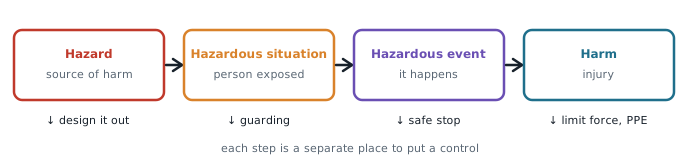
| Step | Meaning | Robot cell example |
|---|---|---|
| Hazard | A potential source of harm | A robot arm that can move fast |
| Hazardous situation | Someone is exposed to it | A technician enters the cell to clear a jam |
| Hazardous event | The thing that causes harm | The arm moves unexpectedly |
| Harm | Injury or damage to health | A crush injury |
A hazard exists whether or not anyone is near it. Keep the four steps separate, because each one is a different place to put a control.
Risk
ISO 12100 splits likelihood into three parts: exposure (how often and how long someone is near), probability of the event, and possibility of avoiding the harm. Reduce any of them and the risk falls.
Same hazard, different risk: a fast robot arm is severity 5 either way. With the operator outside a locked fence, likelihood 1 → risk 5 (low). With a technician teaching it inside the cell at full speed, likelihood 4 → risk 20 (very high). Controls change the risk, not the hazard.
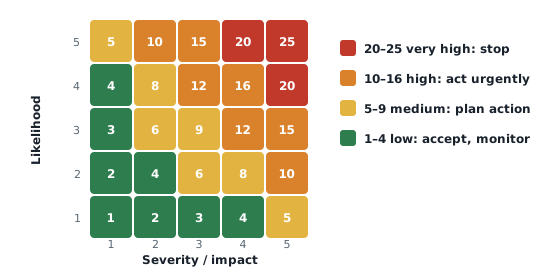
Score impact on safety, operations and cost separately, and take the highest. Matrices give rankings, not measurements: 1 × 5 and 5 × 1 both score 5 but need very different responses. They support judgement; they don’t replace it.
Where hazards come from
ISO 12100 lists mechanical, electrical, thermal, noise, vibration, radiation, substances, ergonomic and environmental hazards. Robotics adds software and control (unexpected restarts, sensor false negatives) and human–robot interaction (shared spaces, bypassed interlocks, cyber attacks).
Look across the whole life: installation, teaching, operation, maintenance and disposal. Most accidents happen in the non-routine stages, when guards are open and people are inside. Also consider reasonably foreseeable misuse, like reaching past a guard to save time.
Finding risks
Write every risk as cause → event → consequence.
| Technique | How it works |
|---|---|
| Checklists, incident data | Compare with known hazards and past accidents |
| What-if / brainstorming | ”What if the light curtain fails?” |
| HAZOP | Guide words (no, more, less, reverse…) applied to each function |
| FMEA (bottom-up) | Each component: failure mode → effect → cause |
| Fault tree (top-down) | From the accident down to causes, through AND/OR gates |
| STPA | Unsafe control actions in a whole system |
The process
Determine the limits → identify hazards → estimate risk → evaluate (acceptable?) → reduce → loop back and check for new hazards. It’s a cycle, kept alive in a risk register with an owner for each risk, reviewed after incidents, changes and near misses.
Register columns: ID · description · cause · likelihood · impact · score · action · control level · residual risk
Controls
Always start at the top of the hierarchy of controls, whatever the score (see Designing for safety). The score sets how urgently you act, not which controls you’re allowed to skip. Controls usually reduce likelihood; severity only drops if the design changes (e.g. limiting a cobot’s force).
When it went wrong
| Case | The failure |
|---|---|
| Ford Flat Rock, 1979 | First recorded robot death: no warning or safeguard |
| Kawasaki, 1981 | Interlock bypassed during maintenance, robot still powered |
| Therac-25, 1985–87 | Hardware interlocks replaced by buggy software |
| Uber, Arizona, 2018 | Pedestrian not classified, emergency braking disabled, safety driver distracted |
| Ocado warehouse, 2021 | Robots collided, causing a battery fire |
Check yourself
1. "The hazard is the technician being crushed." What's wrong with that?
It merges all four steps. The hazard is the moving arm; the situation is the technician in the cell; the event is unexpected movement; the harm is the crush injury.
2. A risk scores 3 × 3 = 9 (medium). Can you go straight to training as the control?
No. Start at the top of the hierarchy (can it be eliminated or engineered out?). The score sets urgency, not which controls to consider.