The idea
Continuing professional development (CPD) is how engineers keep getting better after their degree, and registration expects you to record it. It’s a cycle: work out what you need → learn it however suits you → reflect on what you learned → set the next goal. The skill underneath it is reflection: looking back at an experience honestly enough to change what you do next time.
Where CPD comes from
| Academic | Practical | Professional | Volunteering |
|---|---|---|---|
| Lectures, coursework, software, reports | Projects, competitions, prototypes, internships | Talks, industry visits, institution events, societies | Mentoring, outreach, running a club |
The UK-SPEC CPD code asks engineers to own their development, do a variety of activities, and record, reflect, evaluate and review. They should also support other people’s development.
Gibbs’ reflective cycle
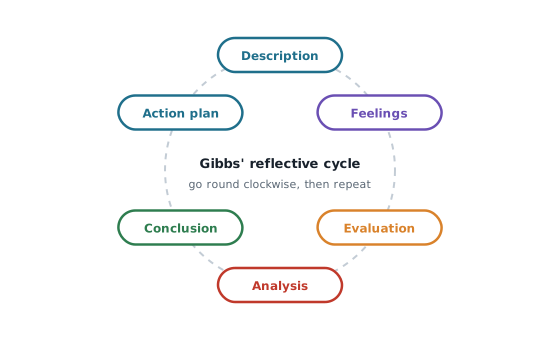
| Stage | Ask |
|---|---|
| Description | What happened? |
| Feelings | What did you, and others, feel? |
| Evaluation | What went well and badly? |
| Analysis | Why did it happen that way? |
| Conclusion | What did you learn? What do you need to develop? |
| Action plan | What will you do next time, and what help do you need? |
The analysis is where most reflections are weak. “The meeting went badly” is a description; “there was no agenda, nobody led, and I didn’t speak up when I could have” is analysis.
SMART goals
| Ask | |
|---|---|
| Specific | What exactly, and what are the steps? |
| Measurable | How will I know I’ve done it? |
| Attainable | Is it realistic for me now? |
| Relevant | Does it link to a real gap or next step? |
| Time-bound | By when? |
Broad: “contribute more confidently in meetings.” SMART: “In each of the next two seminars, bring one prepared question or suggestion, ask a peer afterwards whether it was clear, and record one improvement.”
Evidencing development
A good CPD record links goal → activity and evidence → what I learned → review and next action. Evidence is anything dated and checkable: finished work, feedback, a certificate, a before-and-after comparison.
Check yourself
1. Make this SMART: "get better at CAD".
One option: “Complete the Onshape fundamentals course and model three parts from the lab rig by the end of term, checking dimensions against the drawings.”