The idea
Gears, belts and cords pass motion from one body to another. The key is what’s shared at the contact: where two gears mesh (or a belt grips a pulley without slipping), the touching points move together, so they have the same speed along the contact.
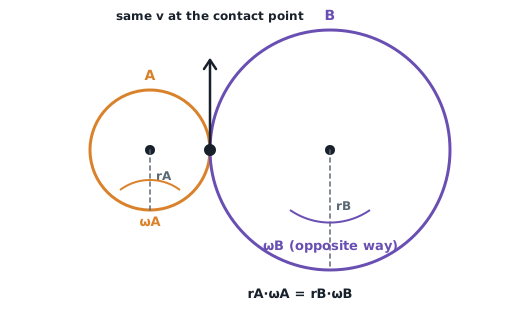
The rules
Meshing gears, and belts or cords with no slip: Things on the same shaft share and .
- A small gear driving a big one slows the output and (ideally) multiplies the torque by the same ratio.
- Meshing gears turn opposite ways. A belt keeps the same direction (unless it’s crossed).
- To go from rotation to a load on a cord or drum: , .
Mechanism vocabulary
- A link is a rigid body with at least two attachment points (nodes). Two nodes = binary, three = ternary.
- Full joints allow one degree of freedom: a pin (revolute) joint allows rotation only; a slider (prismatic) joint allows translation only.
Worked examples
1. A motor’s 20 mm pinion turns at 1500 rpm and drives an 80 mm gear. Output speed and ideal torque ratio?
Answer
rpm, turning the opposite way. The torque is multiplied by (ignoring losses).
2. Gear A (r = 50 mm) starts from rest with rad/s² and drives gear B (r = 150 mm). A 100 mm drum on B’s shaft winds up a cable lifting a load. Find the load’s acceleration and speed after 4 s.
Answer
Mesh: rad/s². The drum shares B’s shaft, so rad/s². m/s² m/s
The pattern for any drive problem
- Find what’s shared at each contact: the same tangential and .
- Convert between linear and angular with at each step.
- Use the constant-α equations if α is constant.
Common mistakes
- Using diameters on one side and radii on the other. Either works, but be consistent.
- Assuming meshing gears have the same ω. They have the same rim speed.
- Forgetting gears on a shared shaft have the same ω even if their radii differ.
Check yourself
1. A 0.15 m pulley at 7.1 rad/s drives a 0.4 m pulley by belt. Speed of the second pulley's rim?
Same as the first: m/s. Its ω is rad/s.