The idea
Two rules let you analyse any circuit. Both are just conservation laws:
- KCL (current law): charge can’t pile up at a junction, so current in = current out.
- KVL (voltage law): energy is conserved round a loop, so the voltage rises equal the voltage drops.
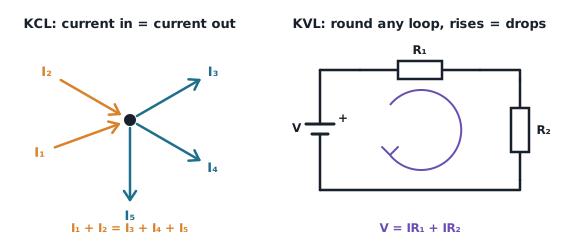
Sign conventions: count currents into a node as + and out as −. If a current you solve for comes out negative, it simply flows the opposite way to the arrow you drew. Keep the sign and carry on.
Sources in a loop: a source that pushes the same way as the others adds; one turned round subtracts. Three cells of 20, 10 and 20 V with the 10 V reversed give V.
Series and parallel
| Series | Parallel | |
|---|---|---|
| Same for each part | Current | Voltage |
| Total resistance | ||
| Two resistors | (product over sum) |
Voltage divider (two resistors in series): Current divider (two in parallel): , the current through one branch uses the other branch’s resistance on top.
The method for any series–parallel circuit
- Reduce the network to one total resistance .
- Total current .
- Work back out: the voltage across each block, then each branch current.
- Check KVL (the drops add up to the supply) and KCL (the branches add up to the total).
- Check the power balance: the power dissipated in the resistors, , must equal the power from the sources, .
The power balance is the best check there is. If it doesn’t balance, something upstream is wrong.
Worked example
A 12 V supply feeds in series with and in parallel. Find every current and check the power balance.
Answer
, so and A. V, so the parallel pair gets V. A, A. KCL: ✓ Powers: W, W, W → total 18 W ✓
Common mistakes
- Adding parallel resistances directly. Parallel always gives less than the smallest resistor.
- In a current divider, putting the branch’s own resistance on top.
- Throwing away a negative answer. It’s information: the current flows the other way.
Check yourself
1. 10 Ω and 15 Ω in parallel?
.
2. A 9 V supply across 1 kΩ and 2 kΩ in series. Voltage across the 2 kΩ?
V.