The idea
Sensors like thermistors, strain gauges and pressure sensors change their resistance by a tiny amount. A Wheatstone bridge turns that tiny change into a voltage you can measure. It’s two voltage dividers side by side, and you measure the difference between their middles.
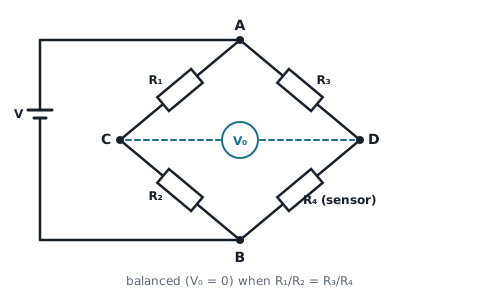
The bridge
Each side is a voltage divider. Measured from B:
It’s balanced () when the two dividers split the voltage the same way:
So if three resistors are known, you can find the fourth by adjusting until the meter reads zero. Because it measures a difference, noise that affects both sides equally cancels out.
Thermistors
A thermistor is a resistor that changes a lot with temperature.
- NTC (negative temperature coefficient): resistance falls as it gets hotter. The common type.
- PTC (positive temperature coefficient): resistance rises. Often used as resettable fuses.
In robots they sense the temperature of battery packs, motors and power electronics, limit inrush current, and trigger thermal shutdowns.
The β model (temperatures in kelvin): is the resistance at (usually 25 °C = 298.15 K) and is from the datasheet.
In a bridge with the thermistor in one arm and in the other three, it balances at 25 °C, and Near 25 °C the output changes by roughly per kelvin, where .
Worked example
A 10 kΩ NTC thermistor ( K) sits in a bridge with three 10 kΩ resistors, fed with 3.3 V. What’s the output at 0 °C?
Answer
K. , × 3950 = 1.213 kΩ (colder, so higher resistance for an NTC) +0.89 V Sensitivity near 25 °C: K⁻¹, so about mV per °C.
Getting accurate readings
| Error source | Fix |
|---|---|
| Self-heating from the measuring current | Keep the excitation current small |
| Resistor tolerance in the bridge | 0.1% resistors |
| ADC offset and noise | Amplify and average |
| β not exact | Calibrate at two known temperatures |
| Long leads | 4-wire connection |
Common mistakes
- Using °C in the β equation. It must be kelvin.
- Forgetting an NTC goes up when it’s cold.
Check yourself
1. A bridge has kΩ, kΩ, kΩ. What balances it?
kΩ.