The idea
A capacitor can’t change its voltage instantly; it has to fill with charge through whatever resistance is in the way. So when you switch on an RC circuit, the voltage climbs along a curve instead of jumping. In a robot this happens every time the power supply charges the capacitor bank (DC link) in front of a motor drive through the cable resistance.
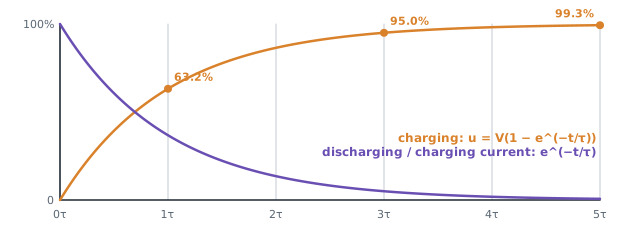
The time constant
| Time | 1τ | 2τ | 3τ | 4τ | 5τ |
|---|---|---|---|---|---|
| Charged to | 63.2% | 86.5% | 95.0% | 98.2% | 99.3% |
After 5τ, call it fully charged (or discharged).
Deriving the curves
This is your first engineering ODE (ordinary differential equation): its answer is a function of time, not a number.
- Component laws: and (current is the rate of change of the capacitor’s charge).
- KVL round the loop while charging from : .
- Separate the variables and integrate from at :
Discharging from (no source, so ):
The minus sign means the current now flows the other way.
Energy
- A charged capacitor holds .
- Charging it through a resistor always wastes exactly as much energy as it stores, whatever R is. Half the energy from the source becomes heat.
Capacitors combine the opposite way to resistors
- Parallel: , same voltage rating. Two 500 µF, 24 V capacitors → 1000 µF, 24 V.
- Series: , voltage ratings add. Two 500 µF, 24 V in series → 250 µF, 48 V.
Worked example
A 12 V supply charges a 100 µF capacitor through 47 kΩ. Find τ, the voltage after 4.7 s and after 10 s, the time to reach 9 V, and the starting current.
Answer
s At 4.7 s (1τ): V At 10 s: V To 9 V: → → s mA. Stored when full: mJ.
Common mistakes
- Using µF without the .
- Using the charging equation for a discharge.
- Taking a log of the wrong side: isolate first, then take ln of both sides.
Check yourself
1. A 10 Ω, 220 µF circuit. How long until it's fully charged?
ms, so about ms.
2. Why is it said a capacitor "looks like a short circuit" at switch-on?
At it has no voltage across it, so the current is the full , as if the capacitor were a wire.