The idea
A battery gives one voltage, but a robot needs several: one for the motors, one for the logic, one for the sensors. A DC-DC converter chops the input with a MOSFET (PWM), then smooths the result with an inductor (which stores energy in its current) and a capacitor (which stores energy in its voltage). The duty cycle sets the output.
Buck (step-down)
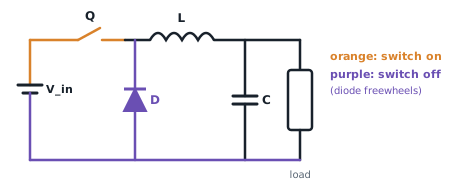
- Switch on: the battery drives current through L into the load. L stores energy.
- Switch off: L keeps the current flowing (inductors resist sudden changes in current), and the diode completes the loop. This is called freewheeling.
Boost (step-up)
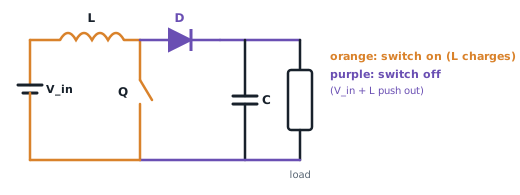
- Switch on: L is connected straight across the battery and charges up. The capacitor feeds the load.
- Switch off: the battery and L push together through the diode, so the output rises above .
Deriving both: volt-second balance
In steady state, an inductor’s average voltage over one cycle must be zero. If it weren’t, its current would keep growing every cycle. So (voltage × time while on) + (voltage × time while off) = 0.
Buck. On for : the inductor sits between and , so . Off for : the diode connects it to ground, so .
Boost. On: . Off: , which is negative.
Sizing the buck’s L and C
Inductor: . While off, for a time , and the current changes by the ripple :
Capacitor: it absorbs the inductor’s triangle-shaped ripple current:
Higher frequency means a smaller L and C, which is why modern converters are tiny. The trade-off is more switching loss.
Worked example
Step a 48 V robot battery down to 24 V at 5 A, switching at 100 kHz, with 10% ripple on both current and voltage. Find D, L and C.
Answer
. A. V. H F
Isolated or not?
| Transformer-less (buck, boost) | Transformer-based (isolated) | |
|---|---|---|
| How | Switch, inductor, capacitor | DC → high-frequency AC → transformer → rectified back to DC |
| Galvanic isolation | No: a fault passes to the load | Yes: protects the user and load |
| Efficiency | 90–98% | 80–95% |
| Size and cost | Small, cheap | Bulkier, costs more |
| Voltage ratio | Low to moderate | Extreme step-up or step-down |
| Outputs | One | One or several |
Buck-boost converters can go either way, which is useful when a battery sags below the output as it drains. Synchronous versions replace the diode with a second MOSFET to cut loss.
Check yourself
1. A boost converter takes 12 V and must output 36 V. What duty cycle?
→ → .
2. In the buck L formula, which voltage goes on top, or ?
. During the off-time, the inductor has across it.