The idea
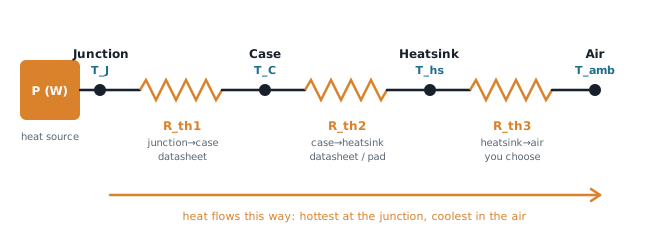
Every watt a component loses becomes heat inside its silicon junction. That heat has to flow out through the case, into a heatsink, then into the air. Each step resists the flow, so the junction ends up hotter than the air. Treat it exactly like Ohm’s law: heat flow behaves like current, temperature like voltage, and thermal resistance like resistance.
| Electrical | Thermal |
|---|---|
| Current (A) | Heat flow (W) |
| Voltage difference (V) | Temperature difference (°C) |
| Resistance (Ω) | Thermal resistance (°C/W) |
| Series resistors add |
| Resistance | From | To | Where you get it |
|---|---|---|---|
| () | junction | case | Datasheet |
| () | case | heatsink | Datasheet (greased), more with an insulating pad |
| heatsink | air | You choose it by picking a heatsink | |
| junction | air, with no heatsink | Datasheet |
Junction temperature
The same heat flows through every step, like current through series resistors. Start from the air, which you know, and climb:
With no heatsink, use the single datasheet value instead: .
The limits:
- Silicon’s absolute maximum is 175 °C. Design for 100–120 °C, and never above 120 °C.
- Safety margin: , aiming for at least 30%. 120 °C gives 31.4%.
Sizing a heatsink
Rearrange for the one resistance you choose:
Put in your target , and the answer is the largest you can get away with. Pick a heatsink at or below it. Lower °C/W means a bigger heatsink.
A negative answer
If comes out negative, even a perfect heatsink () can’t keep the part cool, because alone already make it too hot. The fixes:
- a better interface (thermal grease, about 0.24 °C/W, instead of an insulating pad)
- less loss: lower switching frequency, a part with lower , or MOSFETs in parallel
- a lower ambient temperature, or forced-air or liquid cooling
Worked example
The IRFP140 from MOSFET power loss dissipates 5.36 W in a robot whose electronics bay reaches 35 °C. Datasheet: , (greased), °C/W.
- Can it run without a heatsink?
- What heatsink keeps at 100 °C?
- You fit an 8 °C/W heatsink. What are and the margin?
Answer
- °C. No. It’s far over 175 °C.
- °C/W. Any heatsink at or below 11 °C/W works.
- °C. Margin ✓
Common mistakes
- Adding the thermal resistances but forgetting to add at the end.
- Reading “lower ” as “smaller heatsink”. It’s the opposite.
- Mixing (no heatsink) with the three-step chain. Use one or the other.
Check yourself
1. 40 W, , (insulating pad), 50 °C ambient, target 120 °C. What heatsink?
°C/W. Negative, so it’s impossible. Swap the pad for grease: °C/W, which is a big but possible heatsink.
2. P = 10 W, = 60 °C, = 0.5, 1, 2 °C/W. Find , and .
°C, °C, °C.