The idea
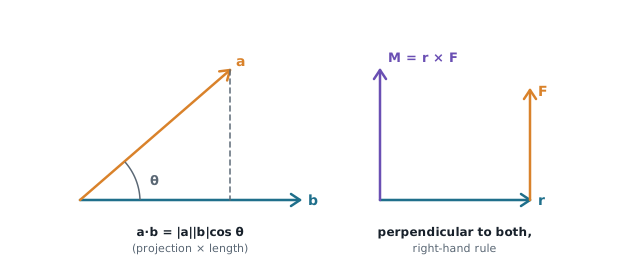
A vector has a size and a direction: position, velocity, force. Mechanics is full of them, and two ways of multiplying them do most of the work: the dot product (how much of one points along the other) and the cross product (turning effect, like a moment).
Writing vectors
- Components: , where are unit vectors along x, y, z.
- Magnitude:
- Direction (2D): . Check the quadrant.
- Unit vector: , length 1.
- Add, subtract and scale component by component.
Dot product (gives a number)
- Use it to find the angle between two vectors.
- Perpendicular vectors have .
- The component of a along b is . That’s how you resolve a force along a direction.
Cross product (gives a vector)
- The result is perpendicular to both, with direction from the right-hand rule.
- Order matters: .
- Main use: the moment of a force, , with first.
Worked example
, . Find , the angle between them, and .
Answer
. , . → Check it’s perpendicular to : ✓
Common mistakes
- Forgetting the minus sign on the term of the cross product.
- Swapping the order in , which flips the moment’s direction.
- Using degrees mode when the question is in radians, or the other way round.
Check yourself
1. A 50 N force acts in the +y direction at a point 0.3 m along x from a pivot. Moment?
N m: 15 N m anticlockwise about z.
2. Are and perpendicular?
Yes: .