The idea
Weeks 1–3 were kinematics: how things move, with no mention of why. Week 4 starts kinetics: the forces that cause the motion. Before you can say whether a mechanism stays put or accelerates, you need two tools:
- Forces, which push or pull a body in a direction
- Moments, which are a force’s tendency to rotate a body about a point
A spanner on a stubborn bolt is the everyday example: the same push does more if you hold the end of the handle, because the turning effect depends on how far the force is from the bolt as well as how big it is.
Moment of a force
The moment of a force F about a point O is
where d is the perpendicular distance from O to the force’s line of action (the moment arm), not just the distance to where the force is applied.
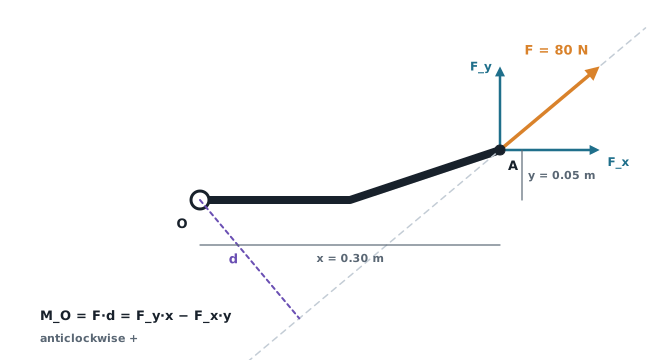
- Sign convention: anticlockwise is +, clockwise is − (the same as the right-hand rule in 2D: anticlockwise in the x–y plane points along +z).
- A force whose line of action passes through O has no moment about O, because d = 0.
- In 3D it’s the cross product , with from O to any point on the line of action (see Vectors).
Varignon’s theorem: use the components
Finding d directly takes trigonometry and is easy to get wrong. The principle of moments (Varignon’s theorem) says the moment of a force equals the sum of the moments of its components. For a force acting at a point (x, y) from O:
Each component has an easy perpendicular distance: is vertical, so its arm is the horizontal distance x; is horizontal, so its arm is the vertical distance y. Think about each one’s turning direction to get the sign.
Worked example
In the diagram, an 80 N force acts at 40° above the horizontal at A, which is 0.30 m to the right of O and 0.05 m above it. Find the moment about O and the perpendicular distance d.
Answer
N · N pushes up at 0.30 m to the right of O: anticlockwise, N·m pushes right at 0.05 m above O: clockwise, N·m N·m anticlockwise m. That’s shorter than the 0.30 m to A, because the force is angled.
Couples
A couple is two forces that are equal in size, opposite in direction and parallel, separated by a perpendicular distance d:
- The two forces cancel, so a couple produces no net force, only rotation.
- A couple moment is a free vector: it has the same effect wherever it’s applied on the body. That’s why a couple doesn’t need a “point”.
- Several couples simply add: .
Example: two hands push a steering wheel with 30 N each, on opposite sides of a 0.36 m diameter rim. The couple is 30 × 0.36 = 10.8 N·m, whatever point you take it about.
Resultant of a force system
Several forces and couples on a body can be replaced by one resultant force at a point O plus one couple, which has the same external effect:
- Forces through O move to O unchanged.
- A force not through O can be moved to O if you add a couple equal to its moment about O.
- Add everything up:
Special cases:
| System | Simplifies to |
|---|---|
| Concurrent (all lines of action meet at O) | Just the resultant force at O; zero moment |
| Parallel forces | One force , placed at d where |
| General coplanar | One force placed so that |
The parallel case is exactly how a centre of mass works: the total weight acts where its moment equals the sum of the parts’ moments (see Centre of mass).
Worked example
A horizontal bar has a 200 N downward load 1 m from O, a 100 N downward load 3 m from O, and a 50 N·m clockwise couple. Find the resultant force, the resultant moment about O, and where a single equivalent force would act.
Answer
N downward N·m, so 550 N·m clockwise One equivalent force: 300 N downward at m from O
Method for moment questions
- Draw the body with all dimensions and an x–y axis.
- Resolve each force into x and y components.
- Find each component’s perpendicular distance to the point.
- Add the moments with signs, and give the answer as a magnitude and a direction (clockwise or anticlockwise).
Common mistakes
- Using the distance to the point of application instead of the perpendicular distance to the line of action.
- Dropping the direction. “12.4 N·m” alone loses marks; say anticlockwise.
- Mixing mm and m. Moments in N·m need distances in metres.
- Forgetting that a couple has no point. Its moment is the same about every point.
Check yourself
1. A 150 N force acts straight down at the end of a 0.4 m horizontal arm pinned at O. What's the moment about O?
N·m clockwise.
2. The same 150 N force now acts along the arm, pulling away from O. What's the moment?
Zero. Its line of action passes through O, so d = 0.
3. A 50 N force at 30° below the horizontal (pointing right) acts at (0.2, 0.1) m from O. Find .
N, N. N·m, so 9.33 N·m clockwise.
Next: using moments and forces to find unknowns, in Static equilibrium and free body diagrams.