The idea
On a curved path, velocity and acceleration become vectors. The velocity always points along the path (tangent to it). The acceleration generally doesn’t, because it’s doing two jobs: changing the speed and changing the direction.
Position, velocity and acceleration as vectors
In x–y components: Magnitudes come from Pythagoras, e.g. .
Averages: uses the straight-line displacement, not the distance along the curve.
Circular motion
For a point moving round a circle of radius (angle in radians):
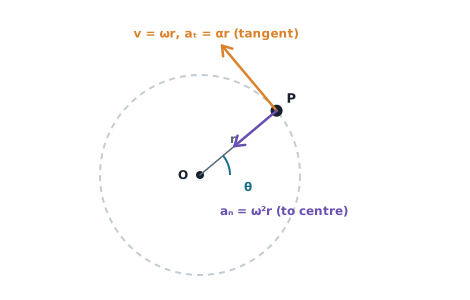
- Tangential changes the speed.
- Normal , pointing to the centre, changes the direction. Even at constant speed, .
- Angular versions of the constant-acceleration equations:
Conversions: 1 rev = rad · rpm × = rad/s
Worked examples
1. A particle’s position is m. Find its speed and acceleration at s.
Answer
→ m/s → m/s², pointing along x
2. A robot wheel of radius 0.25 m spins at 12 rad/s and is speeding up at 5 rad/s². Find the speed and acceleration of a point on its rim.
Answer
m/s m/s², m/s² m/s². The normal part dominates.
Common mistakes
- Using degrees in or . They only work in radians.
- Forgetting when the speed is constant.
- Using distance instead of displacement for average velocity.
Check yourself
1. A point at 0.1 m from an axle turning at 600 rpm. Speed and normal acceleration?
rad/s, m/s, m/s².