The idea
Once a body’s size and shape matter (gears, cranks, linkages), it can’t be treated as a single point. In flat (planar) mechanisms, a rigid body can only move in three ways.
| Type | What happens | In a slider-crank |
|---|---|---|
| Translation | Every line on the body stays parallel to itself. Straight paths (rectilinear) or curved ones (curvilinear) | The slider (piston) |
| Rotation about a fixed axis | Every point moves in a circle round the axis | The crank |
| General plane motion | Translation and rotation at once | The connecting rod |
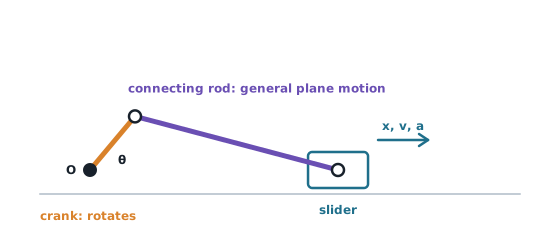
Translation
Every point has the same velocity and acceleration. Treat the whole body as a particle.
Rotation about a fixed axis
A point at radius : , , (see Curvilinear and circular motion).
- Constant α: use the angular constant-acceleration equations.
- α varies with time: integrate, , then .
- α depends on angle: use .
A smooth pin support stops a body moving sideways or up and down, but lets it rotate freely.
Worked examples
1. A motor spins up uniformly from rest to 3000 rpm in 2 s. Find α and how many revolutions it makes.
Answer
rad/s, so rad/s² rad rev
2. A gear starts at 10 rad/s with rad/s². Find ω and θ after 2 s.
Answer
rad/s rad
Check yourself
1. Which type of motion does a lift car have?
Translation (rectilinear): every point moves the same way.
2. A flywheel slows from 50 to 20 rad/s in 6 s at a constant rate. α?
rad/s².