Why this one
One question that uses every Week 1–3 skill: geometry with Pythagoras, position vectors, cross products, relative velocity, relative acceleration (tangential and normal parts), a sliding constraint, and reading the signs of the answers. It’s the same kind of mechanism as the A2 rig, and it’s set up like a test question. Try each part before opening the answer.
Theory: Relative motion analysis · Absolute motion analysis · Rigid body rotation
The question
A slider-crank has crank OA = 0.2 m pinned at O and connecting rod AB = 0.5 m. Slider B moves along a horizontal guide level with O. At the instant shown, the crank is at 60° above the horizontal and is turning anticlockwise at ω = 8 rad/s, and speeding up at α = 30 rad/s².
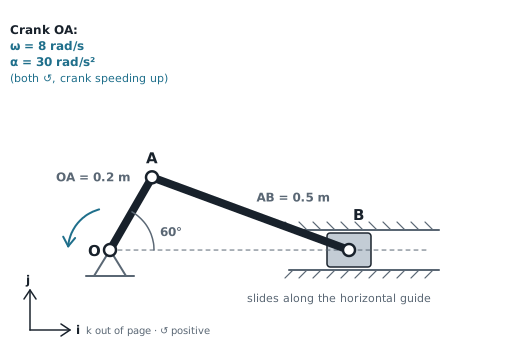
Find:
- (a) The position of B, and the position vector
- (b) The velocity of A
- (c) The angular velocity of rod AB and the velocity of slider B
- (d) The acceleration of A
- (e) The angular acceleration of rod AB and the acceleration of slider B
- (f) Is the slider speeding up or slowing down? Describe the motion of each link.
What's different from the lecture example
Here the crank is speeding up, so A has a tangential acceleration as well as a normal one. The slider moves horizontally, so the constraint kills the j parts instead of the i parts. And the answers come out negative, so you have to interpret the signs.
Set-up
Origin at O, i right, j up, k out of the page, anticlockwise positive. Cross products you need (not on the formula sheet):
(a) Geometry
A:
B is on the line through O, so it’s 0.1732 m below A. Pythagoras on the rod: So from O, and The rod sits at below horizontal.
(b) Velocity of A
Size m/s, perpendicular to OA (up and to the left), as it should be for an anticlockwise crank.
(c) Angular velocity of AB, velocity of B
B can only move along the guide, so (no j part). j (one unknown, so do it first): → , i.e. 1.71 rad/s clockwise
i: , i.e. 1.68 m/s to the left
(d) Acceleration of A
The crank is speeding up, so A has both parts: Check: tangential , normal , total m/s², and ✓
(e) Angular acceleration of AB, acceleration of B
Tangential:
Normal:
j: → anticlockwise
i: , i.e. 10.2 m/s² to the left
Note the square: is positive even though is negative.
(f) Interpreting the answers
- and are both negative (both to the left), so the slider is speeding up as it moves left. Same sign means speeding up; opposite signs means slowing down.
- is clockwise but is anticlockwise, so the rod’s rotation is slowing down at this instant.
- Crank OA: fixed-axis rotation about O (revolute joint). Rod AB: general plane motion (translation plus rotation). Slider B: rectilinear translation along a prismatic joint. Pins at O, A and B plus a prismatic joint between the slider and its guide make a four-link chain (ground, crank, rod, slider) with one degree of freedom: set the crank angle and everything else is fixed.
Answers
| Answer | |
|---|---|
| 0.569 m from O | |
| m/s (1.6 m/s) | |
| 1.71 rad/s clockwise | |
| 1.68 m/s left | |
| m/s² (14.1 m/s²) | |
| 16.2 rad/s² anticlockwise | |
| 10.2 m/s² left (speeding up) |
Common mistakes
- Forgetting A’s tangential acceleration. It’s only zero when the crank turns at a constant rate.
- Using the wrong constraint. A horizontal slider has no j velocity or acceleration, so the j equation is the one with a single unknown.
- Sign of . Square the number, including its minus sign: .
- Getting the wrong way round. It runs from A to B, so here the j part is negative because B is lower than A.
- Reporting a negative as a size. Say “1.68 m/s to the left” or “−1.68 i m/s”, not just “−1.68”.
Check yourself
1. At what crank angle would the rod have zero angular velocity for an instant?
When the crank points straight up or down (90° or 270°). Then is horizontal, the same direction as the slider, so the rod just translates and .
2. If the crank turned at a constant 8 rad/s instead, which terms in part (d) disappear?
The tangential part, . Then m/s², pointing straight at O.