The idea
A body is in equilibrium when it isn’t accelerating, and in static equilibrium when it stays at rest. For a rigid body that needs two things at once:
- No net force, so it doesn’t start translating
- No net moment, so it doesn’t start rotating
In 2D that gives three equations:
Three equations means at most three unknowns per body. Those unknowns are usually support reactions or the force in a link, which is exactly what you need to size a pin, a bearing or a motor.
Newton’s three laws (the foundation)
- A body at rest, or moving at constant velocity in a straight line, stays that way unless a net force acts on it.
- . Equilibrium is the special case .
- Action and reaction are equal, opposite and collinear. A pin pushes on a beam exactly as hard as the beam pushes on the pin.
A car at constant speed is in equilibrium: the traction force exactly equals the drag. While it’s speeding up, it isn’t, and the difference is (see Friction and Newton’s second law).
Supports: what each one can push back with
A support resists the motions it prevents. Replace each support with the reactions it can apply:
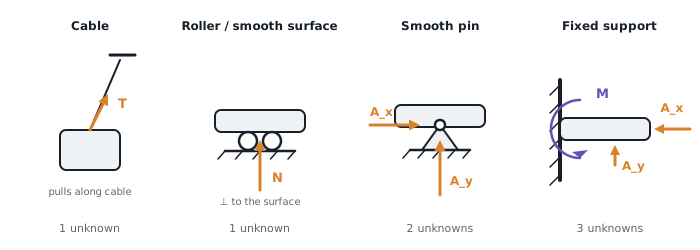
| Support | Stops | Reactions | Unknowns |
|---|---|---|---|
| Cable or rope | Moving away along the cable | Tension, pulling along the cable | 1 |
| Roller or smooth surface | Moving into the surface | A normal force, perpendicular to the surface | 1 |
| Smooth pin (revolute joint) | Translation in any direction | and ; no moment, since it can still rotate | 2 |
| Fixed support (welded or clamped) | Translation and rotation | , and a moment | 3 |
If you guess a reaction’s direction wrong, nothing breaks: the answer just comes out negative, meaning it acts the other way.
Two-force members: a link pinned at both ends with no load in between can only carry force along its length, in tension or compression. That turns two unknowns (, ) into one (the force along the link). Connecting rods and hydraulic cylinders are usually two-force members.
The free body diagram (FBD)
You can’t write the equilibrium equations reliably without one. An FBD shows the body on its own with every external force on it:
- Isolate the body: draw it with nothing attached.
- Draw axes.
- Add the applied loads, including the weight at the centre of mass.
- Replace each support with its reactions from the table above.
- Add dimensions and angles.
Worked example: a beam on a pin and a roller
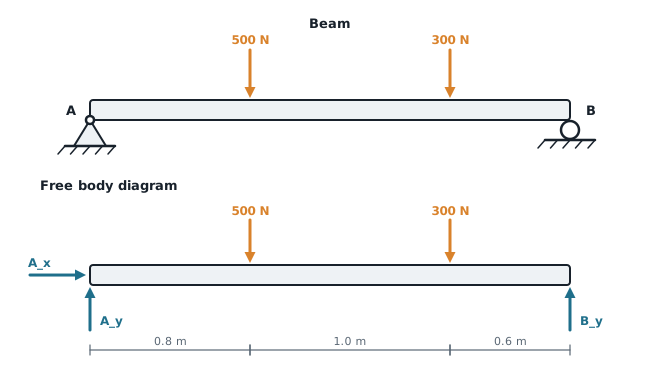
A 2.4 m beam is pinned at A and rests on a roller at B. It carries 500 N at 0.8 m from A and 300 N at 1.8 m from A. Ignore the beam’s weight. Find the reactions.
Answer
Unknowns: , (pin) and (roller): three, so it’s solvable. Moments about A (this kills and , so only one unknown is left): : → 391.7 N ↑ : → N ↑ : no horizontal loads, so Check: moments about B: ✓
The trick that makes these quick: take moments about the point with the most unknowns (usually a pin). They drop out, and you solve for one unknown straight away.
Worked example: a hanging load (concurrent forces)
A 25 kg sign hangs from two cables meeting at a ring. The left cable is at 30° above the horizontal and the right one at 60°. Find both tensions.
Answer
The forces all meet at the ring, so moments give nothing; use the two force equations. N. : → : → N, N. The steeper cable carries more of the load.
Common mistakes
- Leaving a reaction off the FBD, usually the horizontal reaction at a pin.
- Taking moments about a point where nothing cancels, which leaves you with simultaneous equations you didn’t need.
- Putting the weight in the wrong place. It acts at the centre of mass, which for a uniform beam is the middle.
- Mixing up which forces belong to which body when a machine has several parts. Draw a separate FBD for each part, with equal and opposite forces at the shared pins.
Check yourself
1. A 2 m cantilever is fixed into a wall at A and carries 150 N at its free end. Find the reactions at A.
, N ↑, and a moment N·m anticlockwise (it resists the load trying to turn the beam clockwise).
2. A uniform 40 kg plank, 3 m long, rests on supports at its two ends. A 70 kg person stands 1 m from the left end. Find both support forces.
Weights: 392 N at 1.5 m and 687 N at 1 m. Moments about the left end: → N. Then 654 N.
3. How many unknowns does a beam with a fixed support at one end and a roller at the other have, and why is that a problem?
3 + 1 = 4 unknowns, but only 3 equations. It’s statically indeterminate: you’d need the beam’s stiffness to solve it, which is beyond this module.
Next: what happens when the forces don’t balance, in Friction and Newton’s second law.