The idea
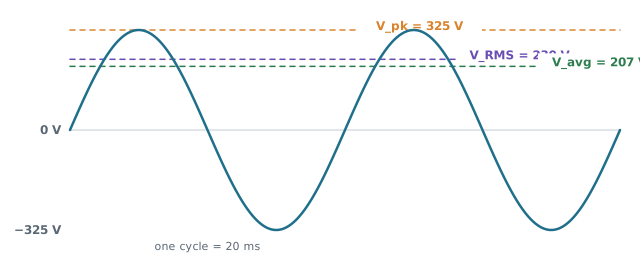
Mains electricity is a sine wave: it pushes current one way, then the other, 50 times a second in the UK. The “230 V” printed on everything isn’t the top of that wave. It’s the RMS value, the steady DC voltage that would heat a kettle by the same amount. The wave itself peaks at 325 V, and any part connected to mains has to survive that peak.
The three numbers
| Symbol | Name | What it is | UK mains |
|---|---|---|---|
| Peak | The top of the wave | 325 V | |
| RMS | The heating-equivalent value. What meters and labels quote | 230 V | |
| Average | The mean height of one hump of the wave | 207 V |
| Convert | Multiply by |
|---|---|
| RMS → peak | |
| Peak → RMS | |
| Peak → average | |
| RMS → average |
Where the numbers come from
RMS means root of the mean of the square. We square because heating power goes as .
- The wave is , so .
- Over a whole cycle, averages to exactly .
- So the mean of the square is , and its root is
Average of one hump = area ÷ width. The area under from to is exactly 2, and the width is :
The same ratios apply to current through a resistive load, so . You’ll need that for bridge losses.
Worked example
A robot’s charger is plugged into a 110 V RMS (US) supply. What peak voltage must its rectifier survive, and what’s the average of each hump?
Answer
V. V (or V). A diode rated V would be fine. At 230 V you’d want 600–800 V.
Common mistakes
- Using 230 V where the question needs the peak. Capacitors charge to the peak, and diodes must block the peak.
- Using RMS current for a diode’s loss. Diodes use average current (see Bridge rectifiers).
- Trusting a cheap multimeter on PWM. Ordinary meters only read RMS correctly for a clean 50 Hz sine. Use a true-RMS meter or a scope.
Check yourself
1. A sine wave has a peak-to-peak voltage of 40 V. What's its RMS value?
Peak = 20 V, so RMS = 0.707 × 20 = 14.1 V.
2. Why is RMS defined with a square?
Because heating power in a resistor is . Averaging gives a voltage that delivers the same power as DC.