The idea
DC motor performance and selection and Stepper motors start from a motor and ask what it can do. This page runs the other way: start from the robot (its mass, wheels, speed, acceleration and the slopes it must climb) and work out the speed, torque and power the motor must provide. It’s the reverse problem, and it’s how you’d choose a motor for a new design.
The forces a drive must overcome
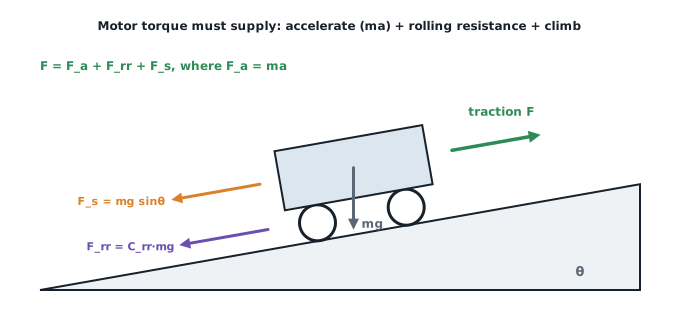
| Force | Formula | Why it’s there |
|---|---|---|
| Acceleration | Speeding the robot up (Friction and Newton’s second law) | |
| Rolling resistance | Tyres deforming on the floor; –0.03 on hard floors | |
| Slope | The component of weight pulling the robot back down |
The worst case is all three at once: accelerating up the steepest slope:
This assumes a hard floor, equal load sharing between the driven wheels and no air drag (which is tiny at walking speeds).
The method
- Speeds: wheel speed (rpm), then motor speed .
- Forces: .
- Torque at the wheels: , shared between the driven wheels: .
- Back through the gearbox (it multiplies torque, but loses some): .
- Add a safety factor (typically 1.5) for slopes, payload and wear: .
- Power: , with .
Then look for a motor whose continuous rated torque, speed and power all exceed these.
Worked example
A 30 kg delivery robot has 0.08 m radius wheels and must reach 1.2 m/s, accelerate at 0.6 m/s² and climb an 8° ramp. , two driven wheels, a 10:1 gearbox at 85% efficiency, and a safety factor of 1.5. What does each motor need?
Answer
1. Speeds: rpm → 1432 rpm 2. Forces: N · N · N N. The ramp is by far the biggest part. 3. Wheels: N·m → N·m per wheel 4. Motor: N·m 5. Rated: 0.48 N·m 6. Power: rad/s → 72 W per motor So you’d look for a motor of roughly 80–100 W continuous, about 0.5 N·m, at around 1500 rpm, with a 10:1 gearbox.
What changes the answer most
| Change | Effect |
|---|---|
| Steeper slope | grows with ; usually the biggest force by far |
| Heavier robot or payload | Every force scales with mass |
| Faster acceleration | Raises , but only during speed-ups |
| Higher gear ratio | Less motor torque needed, but more motor speed |
| Bigger wheels | More torque needed for the same force, less speed needed |
Common mistakes
- Forgetting to share the torque between the driven wheels.
- Multiplying by the gear efficiency instead of dividing. A lossy gearbox means the motor must supply more torque.
- Degrees vs radians in on the calculator.
- Skipping the safety factor, then choosing a motor that runs at 100% on the first ramp.
Check yourself
1. Without the 8° ramp, what would the rated motor torque be in the example above?
N → N·m → N·m → rated 0.19 N·m. The ramp more than doubles the requirement.
2. Why include a safety factor if you've already used the worst-case slope and acceleration?
To cover what the model ignores: heavier payloads, softer floors (higher ), gearbox wear, temperature derating and battery voltage sag. It also keeps the motor’s utilisation comfortably below 100%.
Back to WM1AD, or practise in WM1AD practice questions.