The idea
A DC motor spins for as long as it’s powered; to know where it is, you need an encoder. A stepper moves in fixed, exact steps: one electrical pulse, one step. Count the pulses and you know the position, with no sensor at all (open-loop control). That’s why steppers drive 3D printers, CNC machines, pick-and-place heads and camera mounts: anywhere that position matters more than speed.
How it moves
- The driver energises a pattern of stator coils, which makes a magnetic field.
- The rotor (magnets or a toothed iron core) is pulled into line with it, to the position of minimum reluctance, where the magnetic path is easiest.
- The next pattern moves the field on, and the rotor follows one step.
So:
- Position = the number of pulses sent
- Speed = the pulse frequency
- Direction = the order of the pattern
The driver is essential. A stepper can’t run from a plain DC supply.
Types
| Type | Rotor | Notes |
|---|---|---|
| Permanent magnet (PM) | Magnetised | Coarse steps, cheap |
| Variable reluctance (VR) | Toothed soft iron, no magnet | No holding torque when unpowered |
| Hybrid | Toothed and magnetised | Fine steps and good torque. The robotics standard: 1.8°, 200 steps per revolution |
| Step angle | Steps per rev | |
|---|---|---|
| 0.9° | 400 | Fine robotics positioning |
| 1.8° | 200 | The common choice (NEMA 17 motors) |
| 3.6° | 100 | |
| 7.5° or 15° | 48 or 24 | Usable, but coarse |
Microstepping
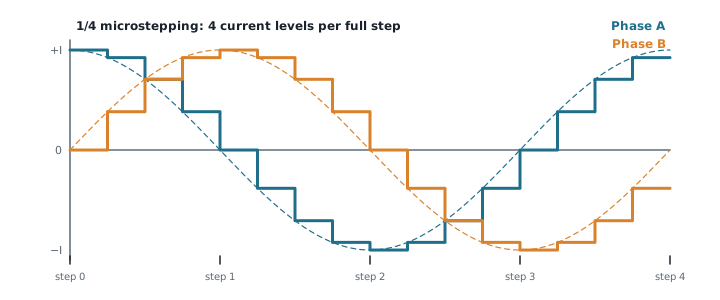
The driver can split each full step into M smaller ones by varying the two phase currents in small increments, following a sine and a cosine, instead of just switching them on and off.
| Mode (1.8° motor) | Angle per microstep | Per revolution |
|---|---|---|
| Full step | 1.8° | 200 |
| 1/2 | 0.9° | 400 |
| 1/8 | 0.225° | 1600 |
| 1/16 | 0.1125° | 3200 |
- Benefit: much smoother, quieter motion, with less vibration and resonance.
- Catch: each microstep has less torque. Under load or friction, the rotor can lag behind or bunch up rather than land exactly on each tiny position. So finer microstepping is smoother, not necessarily more accurate.
- The step angle is a mechanical property of the motor; microstepping is a control method in the driver.
Unipolar vs bipolar
| Unipolar | Bipolar | |
|---|---|---|
| Windings | Centre-tapped; only half of each coil works at a time | The whole coil is used |
| Drive | Four low-side switches; current never reverses (simple) | One H-bridge per phase, so two for a two-phase motor (current both ways) |
| Torque | Lower | Higher: more copper carrying current |
| Use | Simple, educational | Robots, CNC, 3D printers |
Driver chips put both H-bridges on one chip and use current chopping: they sense each coil’s current and switch off the moment it reaches the rated value. See Motor drives.
Strengths and weaknesses
| Strengths | Weaknesses |
|---|---|
| Accurate positioning with no sensor | Missed steps: if the load exceeds the available torque it skips, and with no feedback it doesn’t know |
| High holding torque at standstill | Torque falls as speed rises |
| Simple digital control (step and direction pins) | Resonance at some speeds: noise and vibration |
| Repeatable, brushless (no wear) | Draws current even when holding still: heat and wasted energy |
A 3D printer shows all of these. At power-on it has no idea where the axes are, so it drives each one into an endstop and calls that zero (homing). After that, position is just counted pulses. If the nozzle catches on the print, a motor misses steps, the printer carries on regardless, and every later layer is shifted. That’s a layer shift, the classic open-loop failure. Fixes are a torque margin, gentler acceleration, or an encoder (a “closed-loop stepper”).
The forward problem: is this motor suitable?
Given the motor (step angle, current and resistance per phase, inductance, holding torque , microstepping M, gearbox G, load torque, motor speed in rpm), calculate its performance and check it against the requirements:
Worked example
A 1.8° hybrid stepper: 2.5 A per phase, 0.9 Ω, 3 mH, N·m, 1/16 microstepping, 5:1 gearbox, 0.4 N·m load, running at 150 rpm. The joint needs N·m, rad/s and W. Is it suitable?
Answer
Resolution: 200 steps → 3200 microsteps per rev · · after the gearbox Pulse rates: Hz · kHz Output: rpm · 2.75 N·m ✓ Margins: Electrical: W (11.25 W with both phases on) · ms Power: rad/s → 8.64 W ✓ Speed: 3.14 rad/s ✓ All three requirements pass, but with thin margins (the safety factor is only 1.38, and the power only 8% above the target).
Worked example: a belt conveyor
A 1.8° stepper drives a conveyor belt directly through a pulley of 10 mm radius, with 1/16 microstepping. The belt must run at 50 mm/s. Find the belt movement per microstep, the motor speed and the pulse frequency the microcontroller must produce.
Answer
Belt per revolution mm · microsteps per revolution Per microstep: mm (about 20 µm) Motor speed: rev/s = 47.7 rpm Pulse rate: Hz → 2.55 kHz Quick check: pulses/s ✓ In full-step mode (M = 1) it would be 159 Hz and 0.31 mm jumps: visibly jerky, and in the range where steppers tend to resonate.
Common mistakes
- Treating microstepping as extra accuracy. It’s mainly smoothness.
- Forgetting the gearbox in both directions: output speed ÷ G, output torque × G.
- Using rpm in . Convert to rad/s.
- Bipolar = one H-bridge. It’s one per phase: two for a two-phase motor.
Check yourself
1. Why can a stepper position accurately without a sensor, and what's the risk?
Each pulse is a known, fixed angle, so counting pulses gives the position after homing to a reference. The risk is missed steps under overload: with no feedback, the error goes unnoticed and carries into every later position.
2. A 0.9° motor with 1/8 microstepping turns a 5 mm-pitch lead screw. How far does the nut move per microstep?
400 × 8 = 3200 microsteps per revolution, so 0.0016 mm (1.6 µm).
3. Why do robots use bipolar rather than unipolar steppers?
Bipolar drives use the whole winding, giving more torque from the same size motor. The extra drive complexity (two H-bridges) costs almost nothing now that driver chips contain both.
Next: working out what torque a mobile robot actually needs, in Sizing a drive motor.