The idea
Static equilibrium is the case where the forces balance. When they don’t, the body accelerates, and Newton’s second law tells you how much:
Written in components, it’s the equilibrium equations with on the right instead of zero:
Friction appears in almost every real problem, because it’s what a robot’s wheels push against, and what a gripper relies on to hold things.
Friction
Friction acts along the contact surface, opposing the sliding (or the tendency to slide).
| Formula | When | |
|---|---|---|
| Static | Not sliding. It’s only as big as it needs to be, up to the limit | |
| Kinetic | Sliding. A fixed value |
- is the normal reaction. Find it from the force balance perpendicular to the surface. It’s only equal to on flat ground with no other vertical forces. On a slope, .
- Usually : it takes more force to start sliding than to keep sliding. That’s one reason a mechanism’s start-up effort is higher than its running effort.
- Will it slip? Work out the friction needed to stay put and compare it with . If it needs more than that, it slides, and you switch to .
Method for dynamics problems
- Draw a free body diagram with every force, and choose axes along and perpendicular to the motion (along the slope, for example).
- Draw the kinetic diagram next to it: an arrow in the direction of acceleration. The FBD and the kinetic diagram must be equivalent.
- Write in each direction, for each body.
- Add the constraints: bodies joined by a taut, inextensible rope share the same acceleration size; friction is .
- Solve, then sense-check the direction and size.
Worked example: a block on a slope
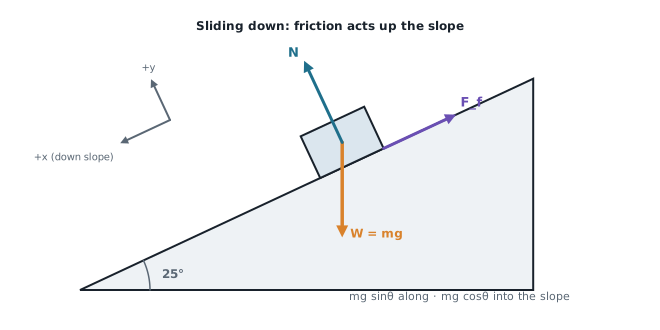
A 12 kg block sits on a 25° slope with and . Does it slide? If so, find its acceleration.
Answer
Perpendicular to the slope (no acceleration that way): N Does it slip? To stay still, friction would need to equal N. The maximum available is N, which isn’t enough, so it slides. (Shortcut: it slides whenever ; .) Along the slope (down = +): → → m/s² down the slope Notice the mass cancels if you write it symbolically: .
Worked example: connected bodies
A 4 kg block on a table () is tied by a light rope over a smooth pulley to a 3 kg mass hanging over the edge. Find the acceleration and the rope tension.
Answer
Same rope, so both move with the same . Take the direction of motion as positive for each body. Hanging mass: Table block: Add the two equations (T cancels): → 2.80 m/s² 21.0 N, which is less than the hanging weight (29.4 N), as it must be for the mass to accelerate downwards.
Rotation: ΣM = Iα
For a body turning about a fixed point, the rotational version of is
For a single small mass at radius r, the mass moment of inertia is . Applying it to a pendulum: the tangential force gives a moment , so .
Worked example: a pendulum at release
A 1.5 kg ball on a 0.8 m string is held at 20° from vertical and released. At the moment of release, find the angular acceleration and the string tension.
Answer
At release it isn’t moving yet (), so there’s no normal (centripetal) acceleration. Tangential: N → 4.19 rad/s² Along the string: → N Once it’s swinging, and the tension rises by .
Why it matters for robots
- Wheel traction: a robot can’t accelerate harder than friction allows: on flat ground. Push the motor beyond that and the wheels spin.
- Motor sizing: the force a drive must supply is plus friction or rolling resistance plus any slope. The same sum appears in Sizing a drive motor.
- Mechanisms: a slider-crank’s joint forces come from on the slider and on the rod.
Common mistakes
- Taking on a slope, or when another force pushes down or pulls up.
- Using for something that’s already sliding.
- Friction in the wrong direction. It always opposes the sliding, so check which way the body would move without it.
- One equation for two bodies. Each body gets its own , linked by the rope tension.
Check yourself
1. A 20 kg crate on the floor ( ) is pushed horizontally with 100 N. Find its acceleration.
N, friction N. 2.06 m/s².
2. What's the steepest slope a robot can climb at constant speed if its wheels have (ignore rolling resistance)?
Grip runs out when : 31°.
3. Why does a mechanism need more torque to start than to keep running?
Static friction is higher than kinetic friction, the motor has to accelerate all the moving masses from rest (, ), and at some positions (a slider-crank near dead centre) the crank has little leverage.
Next: where the weight actually acts, in Centre of mass.